Who gets to name a cyclone? Thirteen countries, one list
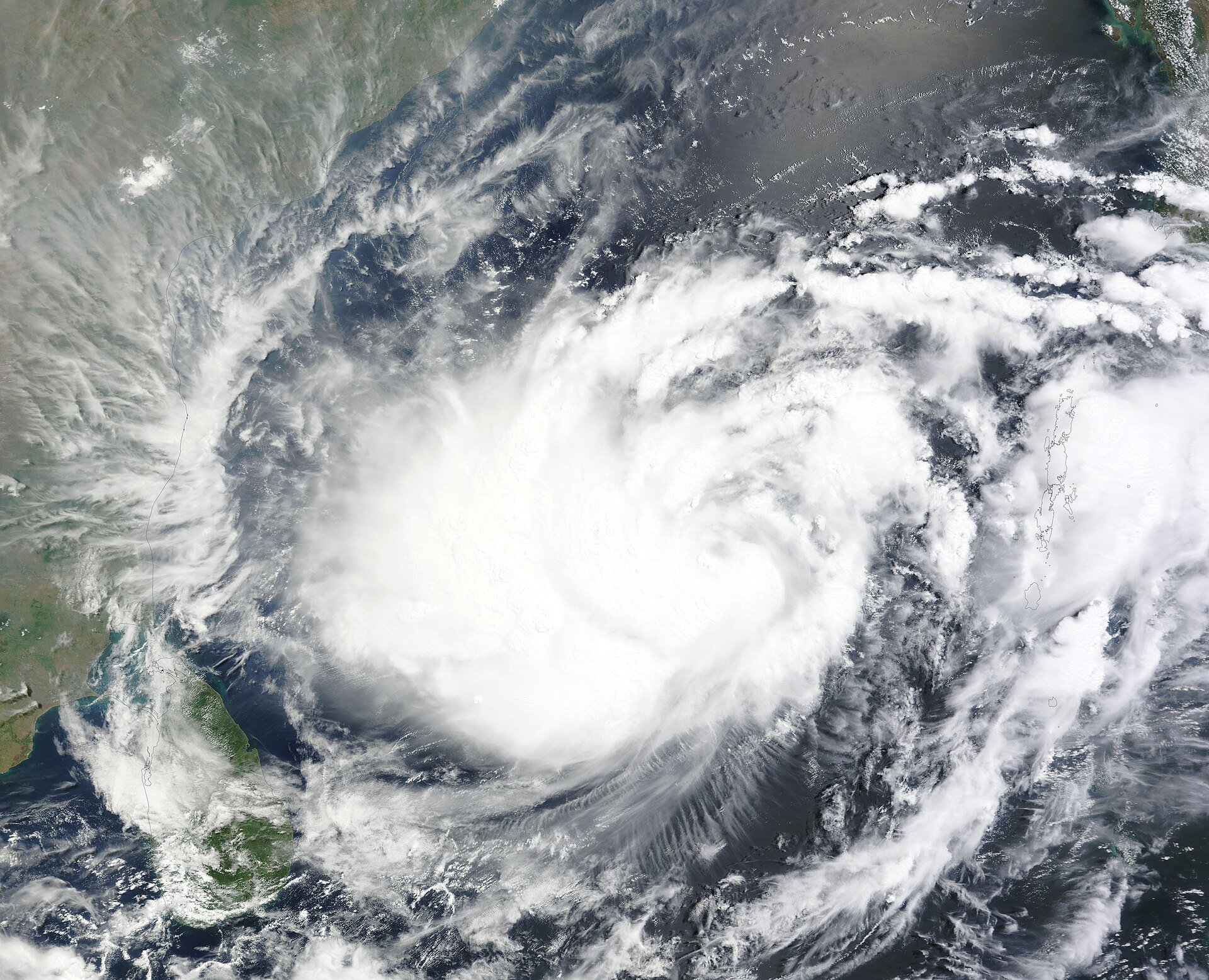
Right now, out in the Bay of Bengal, a big swirl of wind and cloud is gathering strength. It is still far out at sea. But the name it will carry, if it grows strong enough, was chosen years ago and has been waiting on a list ever since.
On 15 November 2026, the India Meteorological Department (IMD) reported a depression over the southeast and adjoining southwest Bay of Bengal, roughly 700 km west-southwest of Sri Vijaya Puram (Port Blair). By the next morning, news reports said it had become a deep depression, and IMD expected it to turn into a cyclonic storm by the evening of 16 November and a severe cyclonic storm on 17 November, moving towards the Andhra Pradesh coast. So who decides what to call it?
A storm's family tree
Weather scientists do not call every swirl a cyclone. They go up a ladder, step by step, depending on how fast the strongest steady winds blow. IMD measures this as the average wind over three minutes, not a single sudden gust.
At the bottom is a low pressure area, with winds under 31 km/h. Next comes a depression, at 31 to 49 km/h. Then a deep depression, at 50 to 61 km/h. Only when winds reach 62 to 88 km/h does IMD call it a cyclonic storm. That is roughly the speed of a car on a highway, but it is the whole sky moving.
The ladder keeps going: severe cyclonic storm (89 to 117 km/h), very severe (118 to 166 km/h), extremely severe (167 to 221 km/h), and finally a super cyclonic storm, at 222 km/h or more. Think of it like a cricketer moving from gully cricket to the Ranji Trophy to the Indian team. Each level has its own badge, and only a proper cyclonic storm earns a name.
The thirteen-country tiffin box
Naming storms in our part of the world is a team job. The group in charge is the WMO/ESCAP Panel on Tropical Cyclones, which brings together weather offices from countries around the Bay of Bengal and the Arabian Sea. WMO is the World Meteorological Organization; ESCAP is a United Nations body for Asia and the Pacific.
The panel agreed in principle to name storms here at a meeting in Muscat, Oman, in 2000, when it had eight members. Naming actually began in 2004. In 2018, five more countries joined the list effort: Iran, Qatar, Saudi Arabia, the UAE and Yemen. That made 13: Bangladesh, India, Iran, Maldives, Myanmar, Oman, Pakistan, Qatar, Saudi Arabia, Sri Lanka, Thailand, the UAE and Yemen.
In April 2020, the members agreed on a fresh list of 169 names, 13 from each country. Picture a giant tiffin carrier where every family adds 13 rotis, and everyone eats in a fixed order. India's contributions include Gati, Tej, Murasu, Aag, Vyom, Jhar, Probaho and Neer.
Who actually hands out the name
The panel writes the list, but someone has to pick the next name at the right moment. That job belongs to the Regional Specialised Meteorological Centre (RSMC) in New Delhi, run by IMD. When a storm in the north Indian Ocean crosses 62 km/h, RSMC New Delhi gives it the next name in line.
The order is strict. Names are used one after another, column by column, like reading a school register from top to bottom. Nobody can skip ahead because they like a different name. In October and early November the Bay already saw storms named Arnab and Murasu, so the next name waiting is Akvan, a name contributed by Iran, according to India TV.
The rules for a good name
Not every word makes the cut. According to Down To Earth's report on the 2020 list, names must be neutral about politics, religion, culture and gender, and must not hurt the feelings of any group. They should not be rude or cruel, and they should be short, at most eight letters, and easy to say.
Each suggestion has to come with its pronunciation and a voice recording, and the panel can reject any name that fails the test. IMD adds that names should be easy to understand when broadcast and must not carry hidden or inflammatory meanings. And once a name is used, it is never used again here.
Why bother at all? IMD says names make it easier for forecasters and the public to talk about warnings. A storm can last a week or more, and there may be two at once. "Cyclone Akvan" is far easier to shout across a fishing harbour than a string of numbers.
What we know, and what we don't
Here is the honest part. Several outlets reported that IMD expects the storm to be called Akvan once it becomes a cyclonic storm. When we checked on the morning of 16 November, the latest reports we could open still described it as a deep depression, and we could not confirm that the name had officially been given.
The landing spot is also unsure. IMD expects it to move north-northwest towards the Andhra Pradesh coast, but Odisha TV reported on 15 November that IMD had not yet named a landfall location. IMD said it may become a very severe cyclonic storm by 19 November. Fishermen have been told to stay off the sea in affected areas.
So what?
A name is not decoration. It is a tool that helps a fisherman in Kakinada, a farmer in Ganjam and a family in Chennai all know they are talking about the same storm. When you hear a cyclone's name on the news, it means the storm has climbed high enough on the ladder to deserve your attention. Follow IMD and local authorities, not forwarded messages, for warnings.
- Storm categories, wind thresholds, 3-minute average, India's names, broadcast criteria, April 2020 list, why names help, November peak: IMD / RSMC New Delhi FAQ
- 169 names, 13 countries, naming rules, 62 km/h, RSMC New Delhi role: Down To Earth
- 2000 Muscat agreement, 2018 expansion to 13, column-by-column order: Factly
- 15 Nov depression location and IMD forecast: Dainik Jagran English
- 16 Nov deep depression status, forecast, track towards Andhra coast, Arnab and Murasu earlier: Oneindia
- Expected name Akvan, contributed by Iran: India TV
- 15 Nov: possible very severe cyclonic storm by 19 Nov; landfall not yet specified; fishermen advisory: Odisha TV
Spotted a mistake or have an idea for a read? Write to [email protected].
