Why Delhi's air turns grey every November
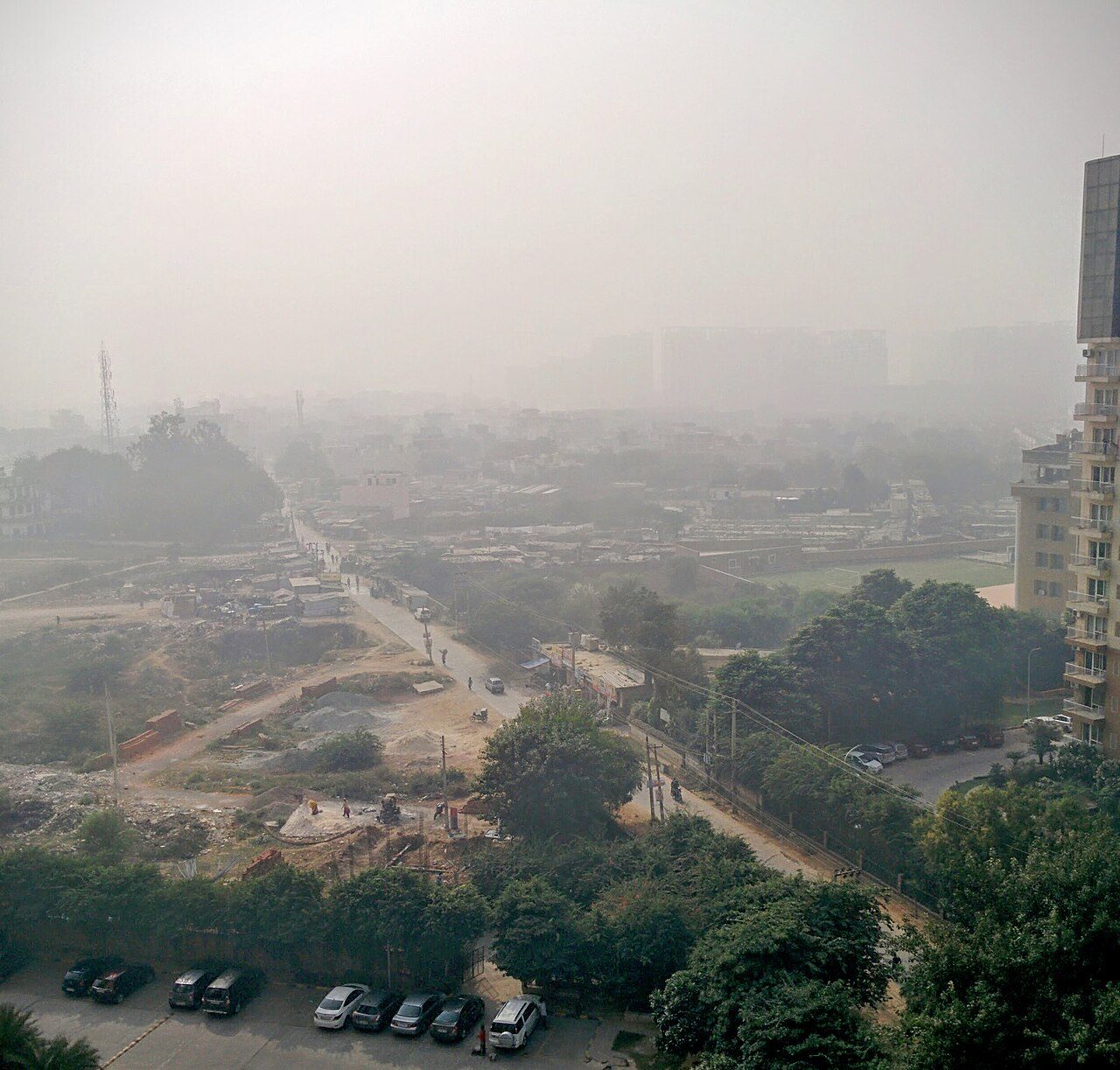
On 30 October this year, Delhi's air quality reading was 60, which counts as 'satisfactory'. Less than a week later, on 4 November, the day's average had climbed to 377. In just a few days the sky over the capital went from blue to dirty grey, and people in Delhi woke up to itchy eyes and that familiar smoky smell.
This happens almost every year, like clockwork, just as the weather starts getting pleasant. So what exactly happens to Delhi's air in November? Let's open the lid on it. Literally.
The invisible lid on the city
On a normal day, the sun warms the ground, and the ground warms the air just above it. Warm air is lighter, so it rises, carrying smoke and dust up and away, like steam rising from a cup of chai. Higher up, the air gets colder and colder.
On cold winter nights something odd happens. The ground loses its heat quickly, so the air touching it becomes cold, while a layer of warmer air sits on top. Scientists call this a temperature inversion, because the usual order is turned upside down.
Think of it as a lid on a pressure cooker. The cold air near the ground cannot rise through the warm layer above it, so everything we put into the air (exhaust, dust, smoke) stays trapped close to where we breathe. Cities and valleys are hit hardest. Winter nights are exactly when these lids form most often.
No breeze to sweep it away
A lid alone would be bad enough. But in late autumn, Delhi's winds also turn slow and lazy. In the monsoon, strong winds and rain wash the air clean. In November, the air just sits there, like a room with the fan switched off and the windows shut.
When the wind does blow, it often comes from the north-west, from the direction of Punjab and Haryana. That brings us to the next suspect.
Who is filling the room with smoke?
Stubble burning: After the rice harvest, some farmers set fire to the leftover straw, called stubble, to clear fields quickly for the next crop. On 4 November, satellites spotted 467 farm fires across six states, 151 of them in Punjab. On that day, a government forecasting system estimated that stubble smoke made up about 20% of Delhi's pollution. That share goes up and down a lot from day to day, depending on the wind.
Vehicles: Cars, trucks, buses and two-wheelers run every single day, monsoon or winter. On the same day, transport was estimated at about 15.5% of the pollution. Their smoke is not new in November. It just has nowhere to go.
Dust: Dust from roads and building sites is a big part of the mix. That is why a big step in Delhi's emergency plan is stopping construction work.
Firecrackers and winter fires: Diwali fell on 8 November this year. The next early morning, one monitoring station at ITO in central Delhi showed a reading of 406, which is in the 'severe' range. Burning wood and waste to keep warm on cold nights adds even more smoke.
No single villain makes Delhi's smog. It is more like a tiffin box packed by many hands, all sealed under the same tight lid.
What the AQI number is telling you
The Air Quality Index, or AQI, squeezes many measurements into one simple number from 0 to 500. The most worrying ingredient is PM2.5: specks of dust and soot so tiny that roughly 25 to 100 of them, side by side, would fit across the width of a single hair. They are small enough to slip deep into our lungs.
Here is how to read the scale. 0 to 50 is good. 51 to 100 is satisfactory. 101 to 200 is moderate. 201 to 300 is poor. 301 to 400 is very poor. Anything above 400 is severe. So when the news says Delhi is at 380, it means the city is near the top of 'very poor', only a short step below 'severe'.
GRAP: Delhi's emergency ladder
To fight back, Delhi and its neighbouring areas follow a plan called GRAP, short for Graded Response Action Plan. 'Graded' just means step by step, like climbing a ladder. As the AQI climbs, the rules get stricter. A body called the Commission for Air Quality Management (CAQM) decides when to move up a step.
Stage I kicks in when the AQI is 'poor' (201 to 300). Stage II is for 'very poor' (301 to 400). Stage III is for 'severe' (401 to 450), and Stage IV, the strictest, is for anything above 450.
This November the ladder was climbed quickly. Stage II came into force across Delhi-NCR on 2 November. On 6 November, with the city's AQI at 380, Stage III was ordered. Under it, most construction and demolition work stopped, and older BS-III petrol and BS-IV diesel cars were kept off Delhi's roads. Each stage adds its rules on top of the ones before it.
So what?
If you live in north India, the AQI is worth checking just like the weather. On 'very poor' or 'severe' days, children, older people and anyone with asthma are best kept away from long outdoor exercise, especially on cold, still mornings.
Even if you live far from Delhi, the same science works in your city. Cold, still nights trap whatever we put into the air. That is why cleaner fuels, fewer farm fires and less dust help everyone, and why the rules get tougher the moment the number climbs.
- AQI rise from 60 to 377; 467 farm fires; stubble 20.2%, transport 15.5%: Business Today
- GRAP Stage II imposed on 2 Nov 2026: The Week (PTI)
- GRAP Stage III on 6 Nov at AQI 380; construction ban; BS-III/BS-IV curbs: All India Radio News (NewsOnAir)
- Post-Diwali readings (ITO 406); GRAP III still active: Asia News Network
- What a temperature inversion is; London smog 1952: Wikipedia
- AQI categories and GRAP stage thresholds: Outlook India
- Winter causes (stagnant winds, crackers, heating); PM2.5 size: Wikipedia
Spotted a mistake or have an idea for a read? Write to [email protected].
