Voyager 1 becomes the first spacecraft a full light-day from Earth
NASA says the 1977 probe crosses the 25.9-billion-km mark at 3:46 pm IST on Wednesday, so far away that a radio message takes a whole day to reach it.
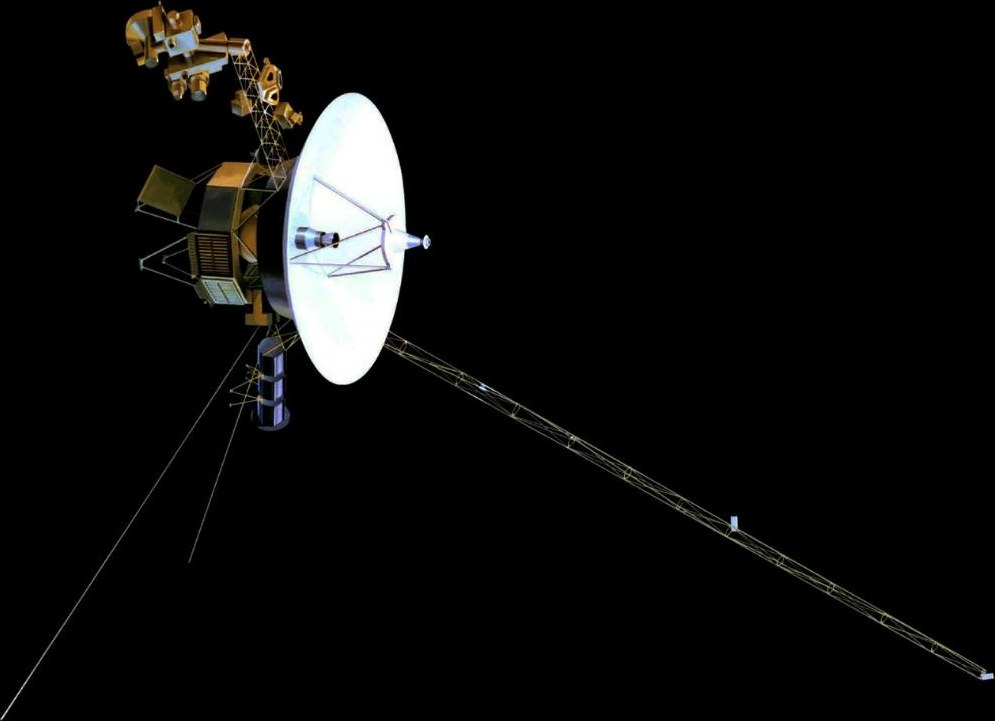

At 3:46 pm IST on Wednesday, 18 November, a machine built in the 1970s does something no human-made object has ever done. NASA says Voyager 1 reaches one light-day from Earth: the distance light covers in 24 hours, about 25.9 billion km.
Put simply, if you shone a torch towards Voyager 1 on Wednesday, the light would take a whole day to catch up with it. Radio signals travel at the speed of light too, so a command NASA sends today reaches the spacecraft only a day later, and the reply needs another day to come home. For scale, NASA notes light reaches the Moon in about 1.3 seconds and gets from the Sun to us in roughly eight minutes and 20 seconds.
The exact moment, per NASA's mission page, is 5:16:07 am US Eastern time on 18 November, which is 3:46 pm in India. One light-day works out to 25,902,068,356 km. Voyager 1 is getting there 49 years, 2 months and 11 days after it was launched on 5 September 1977.
So how is it still going? Voyager 1 flew past Jupiter and Saturn, and its main planet-visiting mission ended after the Saturn flyby in 1980, Al Jazeera reports. It just kept flying outward, and NASA says it crossed into interstellar space, the region beyond the Sun's bubble of solar wind, in August 2012. NASA puts its speed at nearly 61,000 km an hour.
It runs on plutonium-based power that weakens every year, so engineers have been switching systems off one by one to save energy. EarthSky reports NASA turned off one science instrument, the Low-Energy Charged Particle instrument, in April 2026. Even so, Al Jazeera says the probe still sends back daily data on magnetic fields, pressure, dust and cosmic rays, and a small engineering team sends it commands roughly once a week. Voyager project manager Suzanne Dodd called it "a national treasure", the report says.
It hasn't all been smooth sailing. Al Jazeera reports that contact with Voyager 1 was briefly lost in October, and the cause still isn't known.
NASA turned the milestone into a public moment, too. It invited people around the world to flash the letters V-G-R in Morse code at the sky after sunset on Tuesday, using a phone, a torch or NASA's own flasher app.
Where does it go from here? Nowhere fast, by cosmic standards. NASA says Voyager 1 is drifting towards a star called Gliese 445 (AC +79 3888), more than 17 light-years away, and will pass within about 1.7 light-years of it in roughly 40,000 years. Its twin, Voyager 2, launched two weeks earlier on a different path, is expected to reach the same one-light-day mark in November 2035.
What nobody knows yet is how long the old probe can keep talking. NASA hasn't set an end date, and with its power dropping every year, engineers will keep having to choose what to switch off next.
Get the day's best stories on WhatsApp. Free, a few a day, no spam.
Follow on WhatsAppSource ledger · स्रोत खाता
Each fact in this story, where it came from, and how it was checked.
| Fact | Source | Check |
|---|---|---|
| Milestone time 5:16:07 am EST 18 Nov 2026; light-day = 25,902,068,356 km; 49 yrs 2 mths 11 days after 5 Sep 1977 launch; ~61,000 kph; interstellar space Aug 2012; Gliese 445 / 1.7 ly in ~40,000 yrs; Voyager 2 in Nov 2035; light to Moon 1.3 s, Sun 8 min 20 s | NASA Science | Confirmed, official source |
| Public invited to flash V-G-R in Morse code after sunset Tue 17 Nov; flasher app | NASA Science | Confirmed, official source |
| Crossing at 10:16:07 UTC 18 Nov (= 3:46 pm IST); ~25.9 billion km; one-way messages take about a day; LECP instrument turned off April 2026 (SINGLE for LECP) | EarthSky | Confirmed, independent outlets |
| Primary mission ended after 1980 Saturn flyby; plutonium-powered; daily data on magnetic field, pressure, dust, cosmic rays; commands about once a week; brief loss of contact in October, cause unknown; Suzanne Dodd quote | Al Jazeera | Single source |
Corrections to this story: none.